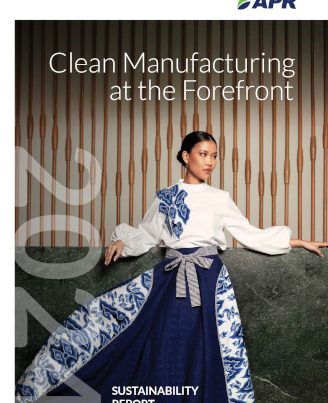
Asia Pacific Rayon (APR) has released its seventh annual Sustainability Report, highlighting a year of resilience, progress and purposeful transformation.
Themed “Growing Value, Sustaining Progress,” the 2025 report highlights APR’s continued efforts to strengthen its operational performance while advancing its sustainability commitments across its operations, environmental performance and engagement with local communities.
“We have made viscose staple fibre (VSF) productivity a strategic priority in recent years through targeted investments and operational improvements that have steadily moved the company forward,” said Saleel Rajaram Nayak, APR Head of Operations.
This focus was reflected in APR’s 2025 performance, with VSF production increasing to 325,411 tonnes, a 3% increase from the previous year.
APR also recorded progress across several key environmental performance indicators. Compared with its 2019 baseline, cumulative reductions of 93.3% in greenhouse gas (GHG) emissions, 63.5% in sulphur emissions, 38.3% in water consumption and 49.6% in waste intensity across its operational footprint.
The company’s sulphur recovery rate also increased to 94.9% in 2025, reaching the level required under the European Union Best Available Techniques (EU-BAT) standards and the Zero Discharge of Hazardous Chemicals (ZDHC) Progressive Level.
APR’s environmental performance was also recognised through the Green Industry Award 2025 from Indonesia’s Ministry of Industry, the first such recognition for a VSF producer in the country.
Beyond its operational and environmental performance, APR continued to engage with local communities and support the development of the local fashion ecosystem. In 2025, APR supported local artisans and creatives by providing opportunities to showcase fashion pieces made using APR’s viscose at key events including Jakarta Fashion Week (JFW), Jakarta Muslim Fashion Week (JMFW), and Riau Berkain.
APR also collaborated with the Indonesian Textile Association Riau (API Riau) to support local fashion small and medium-sized enterprises (SMEs) through its Kelas Berbagi workshops, providing opportunities to strengthen knowledge and capabilities.
As part of its commitment to building a more inclusive workplace and advancing gender equality, women represented 30.8% of APR’s total workforce in 2025, including 16.7% of management positions.
Sustaining progress towards 2030
These efforts contribute to APR2030, APR’s long-term sustainability commitment, which provides a framework for actions across four pillars: Climate & Nature Positive, Clean Manufacturing, Circularity and Inclusive Prosperity.
The 2025 Sustainability Report provides an overview of APR’s continued focus on creating value while making progress towards its 2030 sustainability commitments.
Read the full 2025 Sustainability Report here. Explore the APR2030 commitment pillars: